Custom Business Systems Portfolio application

Meridian Venue Intelligence Platform

A venue operations analytics platform that turns uploaded performance data into clearer revenue, utilization, zone, and reporting insights.

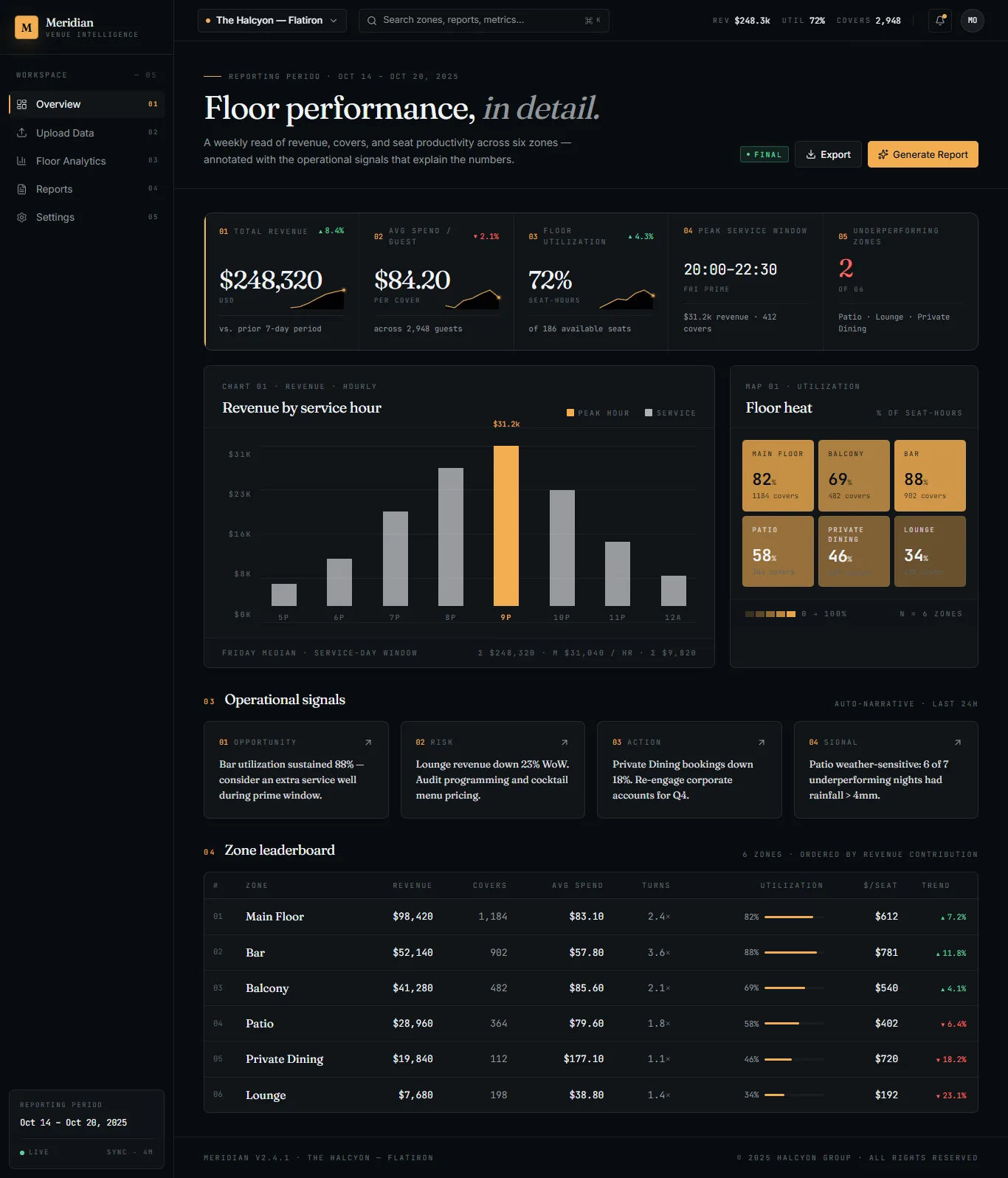
Meridian venue performance overview dashboard

Project context

Compact project facts.

Industry

Venue Operations / Hospitality Analytics

Company size

Operations team managing a multi-zone venue

Project type

Operational analytics and reporting platform

Service line

Custom Business Systems

Status / reference

Portfolio application

Before

Before the build

Venue operators needed a clearer way to review revenue, covers, utilization, zone performance, and weekly signals without repeatedly assembling reports by hand.

Raw CSV or spreadsheet exports required manual review.

Zone performance was difficult to compare consistently.

Weekly reporting depended on repeated manual assembly.

Management visibility was spread across multiple metrics and sources.

Underperforming areas were harder to identify quickly.

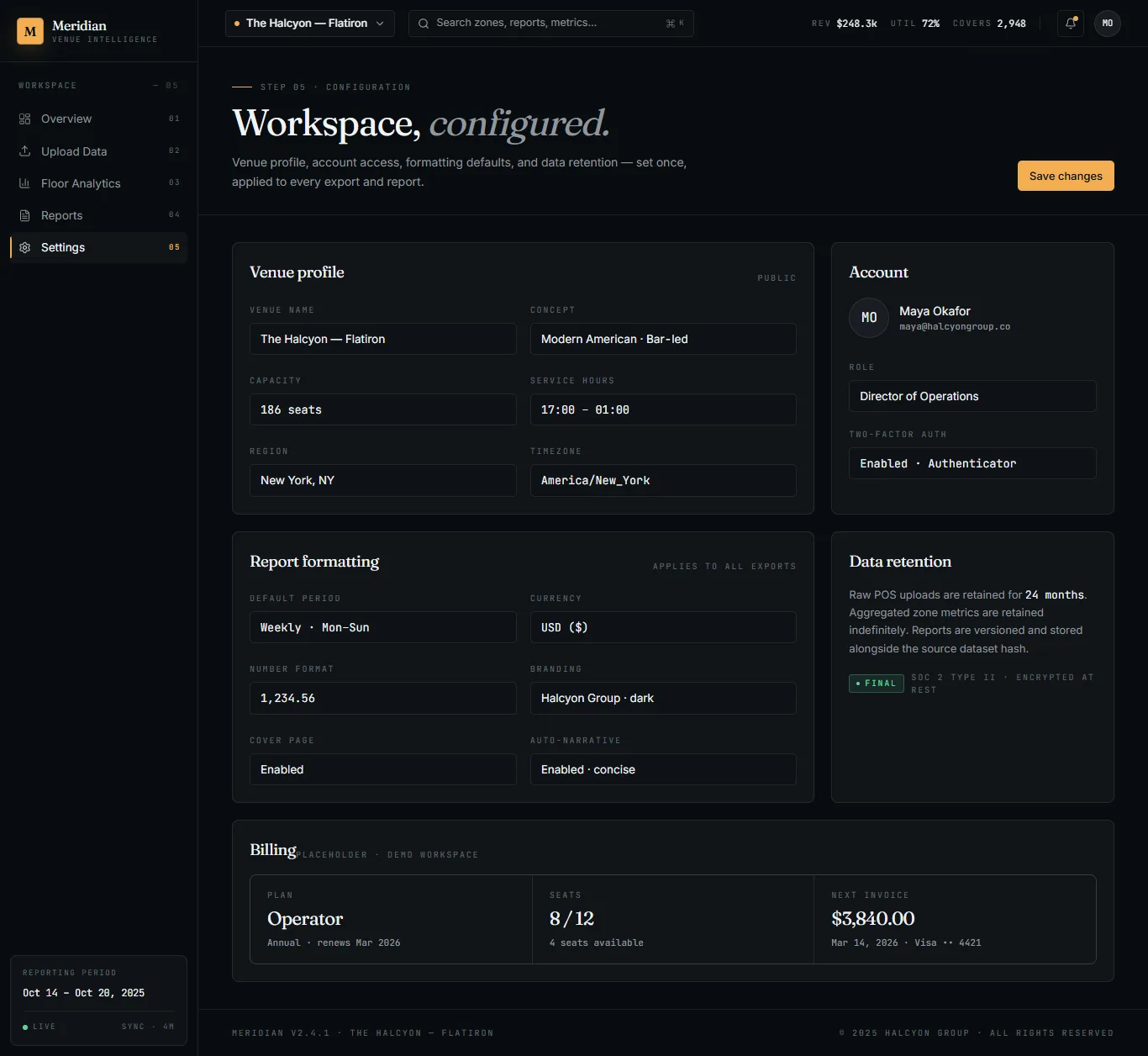
Report formatting and retention settings lacked one central place.

Build

What was built

Delivered scope

  • Overview dashboard with revenue and utilization KPIs
  • Hourly revenue chart, floor heat, and zone comparisons
  • Operational signals and zone leaderboard
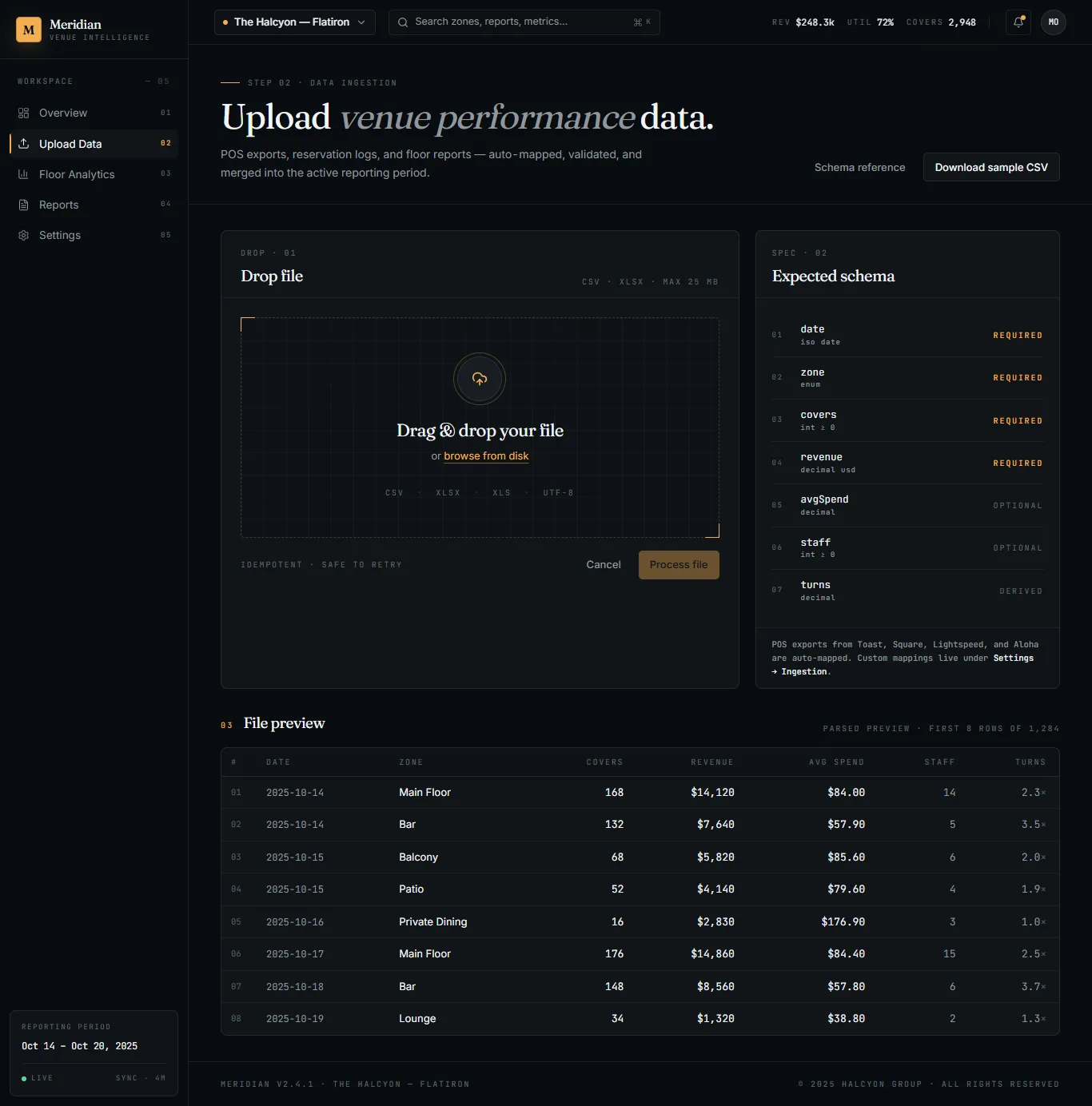
  • CSV and XLSX upload workflow with schema guidance and preview
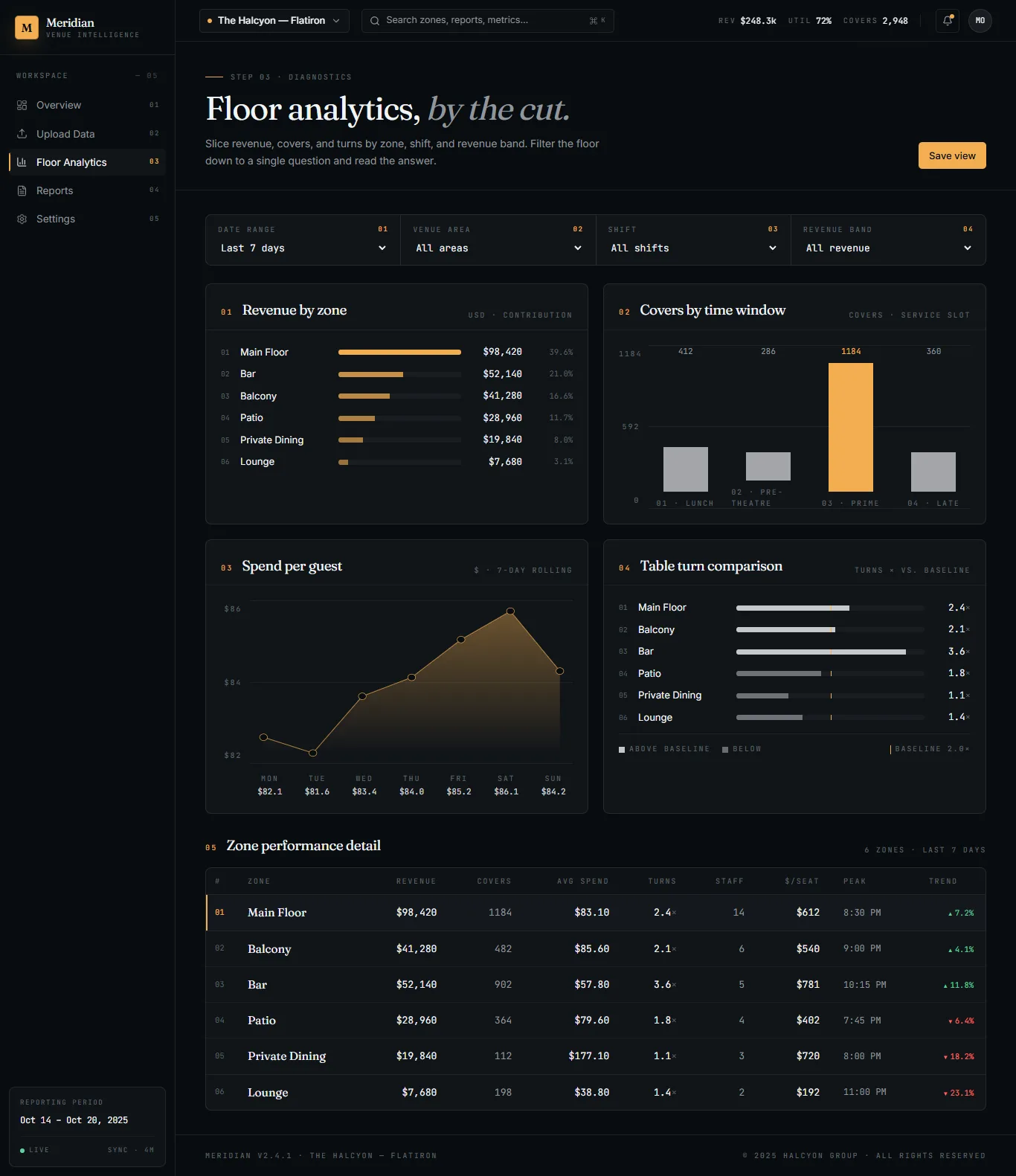
  • Floor analytics filters and comparison views
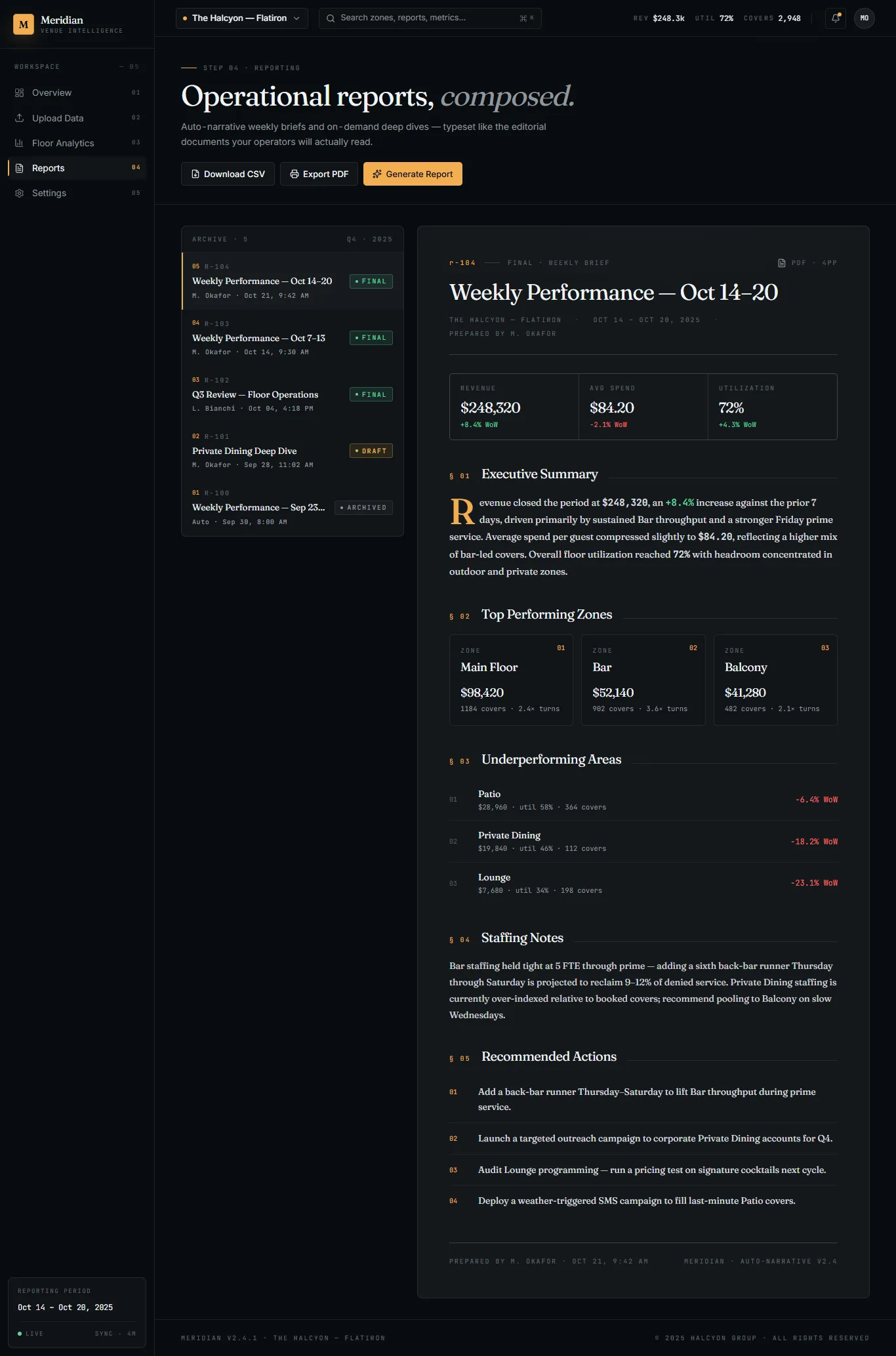
  • Reports archive and weekly brief view
  • Represented PDF and CSV export controls
  • Venue settings, reporting preferences, and data-retention configuration
  • Responsive application layout

Core functionality

  • Venue performance overview
  • Revenue by service hour
  • Floor utilization heatmap
  • Zone performance tables
  • Spend per guest and covers by time window
  • Table turn comparison
  • Upload and schema-validation interface
  • Report generation and archive views
  • Workspace, account, and access settings

Architecture

How the system was structured

The application was designed as a product-style analytics interface with reusable dashboard patterns, structured data ingestion flows, configurable reporting views, and operational reporting screens.

  • Dashboard application
  • Structured data upload and schema-validation interface
  • Analytics views with configurable filters
  • Reporting interface and represented export controls
  • Settings and workspace configuration
  • Reusable component system
  • Responsive design

Decisions

Key decisions

These choices shaped the build around the workflow problem instead of adding features for their own sake.

  • Separated overview, diagnostics, reporting, and settings into clear workflows.
  • Used zone-level comparisons rather than relying only on top-level totals.
  • Surfaced operational signals separately from raw metrics.
  • Designed uploads around schema clarity and retry-safe processing language.
  • Made reporting settings explicit instead of hiding them.
  • Kept the interface product-focused instead of using a generic admin template.

Outcome

What changed

The product concept centralizes venue performance views, structured upload guidance, zone comparisons, weekly reports, and reporting configuration in one application flow.

  • Centralized venue performance reporting
  • Clearer comparison across zones
  • Easier review of revenue, utilization, and spend
  • A more coherent weekly reporting workflow
  • Stronger visibility into underperforming areas
  • More structured data-ingestion and report-configuration flows

Portfolio application: Product concept shown through the portfolio interface

Explore venue operations and analytics systems

Buyer trust

What this demonstrates

  • Operational dashboard design
  • Data-heavy interface design
  • Reporting workflow design
  • Structured upload and validation UX
  • Analytics product thinking and management visibility
  • Product-quality internal software UI
  • Custom systems positioning

Next step

Working through a similar workflow problem?

Start with the current process, where it breaks down, and what should be better after the first phase.