Financial operations

Ledger and financial operations systems built around tenant isolation, transaction integrity, and traceable account activity.

Financial workflows cannot be treated like ordinary form submissions. Accounts, balances, transfers, and transaction history need explicit rules, transactional behavior, authorization, idempotency, and reliable tenant scoping.

Common financial operations problems

Financial integrity breaks down when domain rules remain implicit.

  • Balances are updated directly instead of derived from journal activity.
  • Duplicate transfer requests can create repeated postings.
  • Failures can leave partial writes when posting is not transactional.
  • Account classifications are inconsistent across features.
  • Tenant scope is applied unevenly to accounts and history.
  • Authorization is enforced in navigation but not consistently on the server.
  • Transaction history is difficult to trace or audit.
  • Financial records are spread across unrelated tables.
  • Retries are not designed as a normal part of financial write behavior.
What can be built

Ledger and operations tools shaped around explicit financial workflows.

Multi-tenant ledger platformsAccount management and chart of accountsBalance enginesWallet ledgersMarketplace balancesInternal financial operations toolsTransaction historyTransfer workflowsReconciliation supportReporting dashboardsAudit-oriented recordsFinancial admin portals

Payment processing and banking connectivity are not implied unless separately integrated.

Best fit

Products that need trustworthy internal balances and traceable activity.

Fintech startupsSaaS products with internal balancesMarketplacesWallet productsSubscription platformsInternal finance teamsPayment-adjacent productsMulti-tenant business platformsProducts that need traceable financial records

Relevant proof

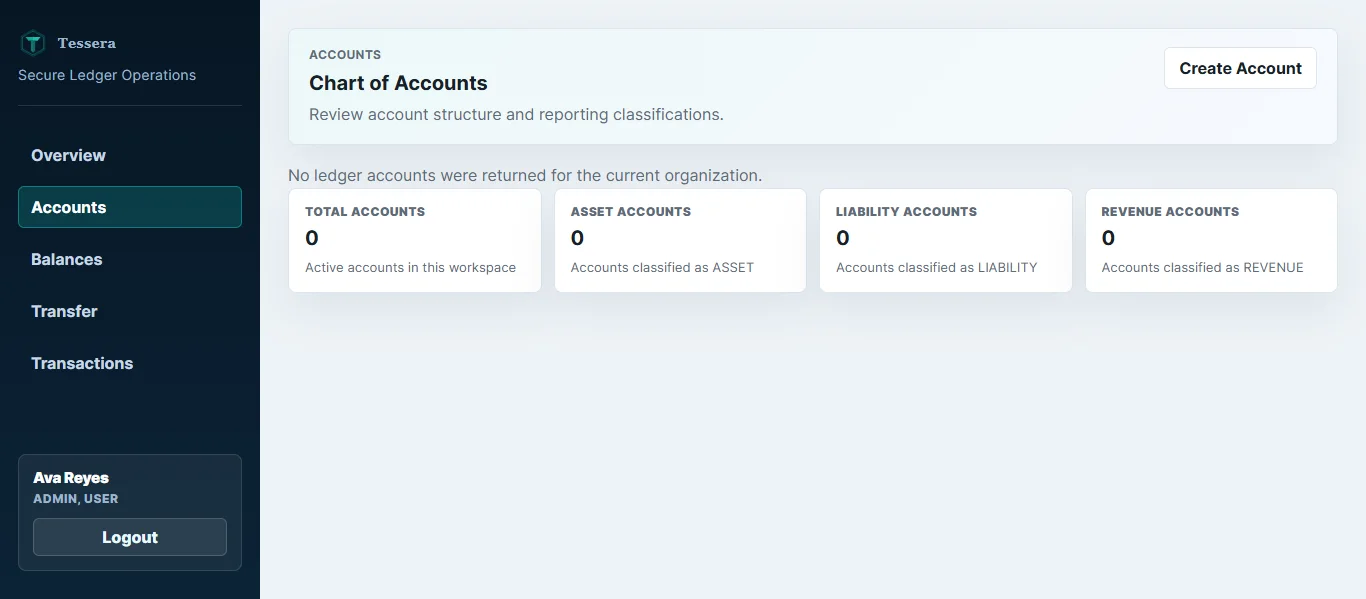
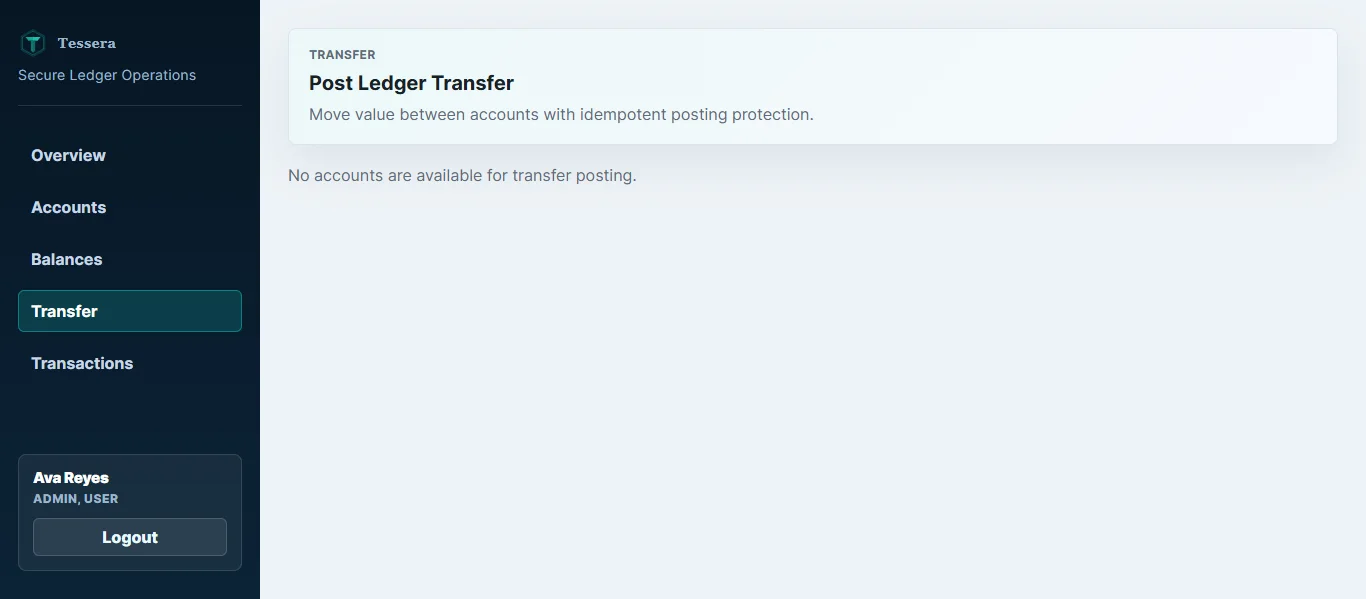
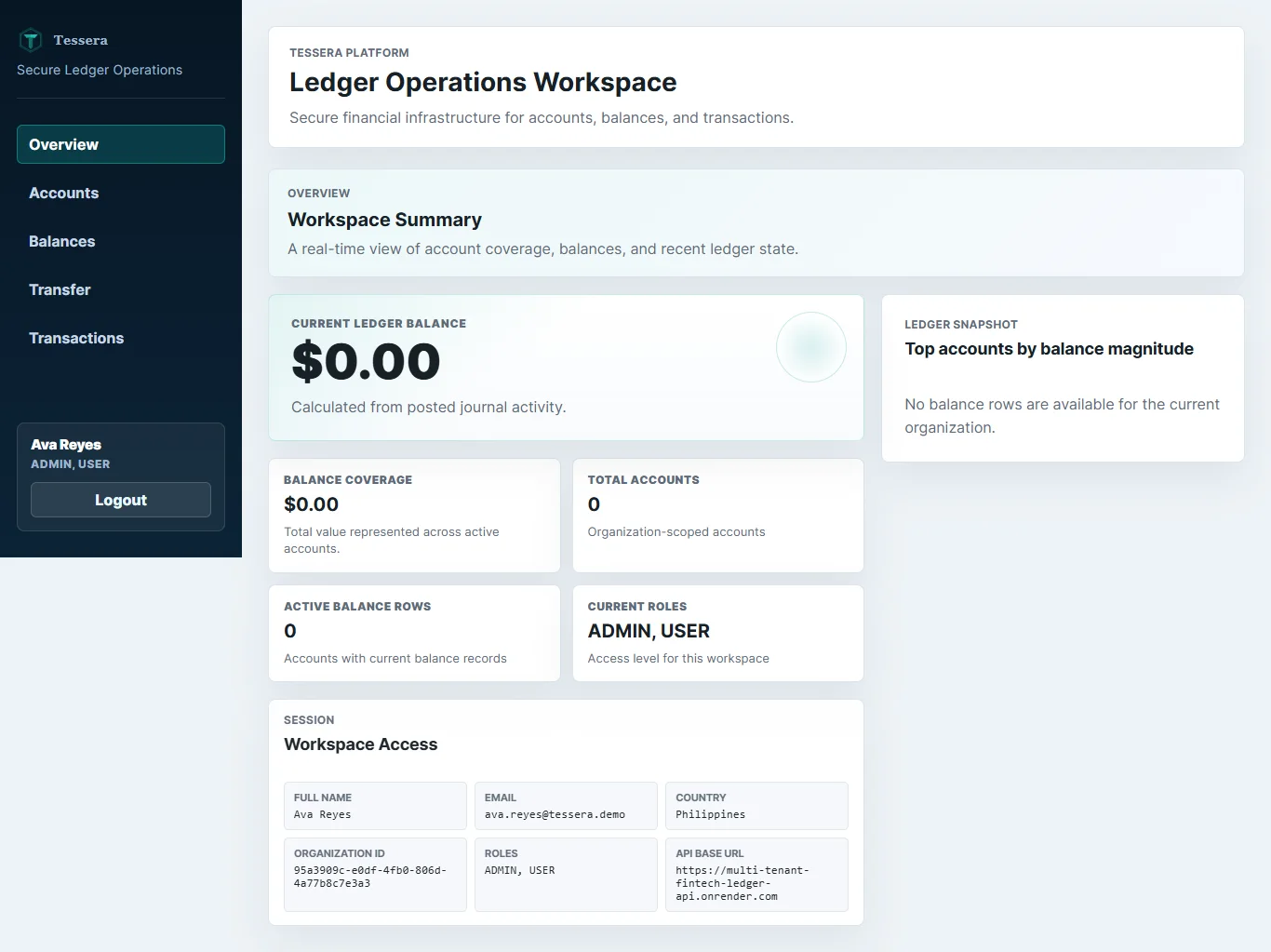
Ledger operations workflow in practice

Tessera Multi-Tenant Ledger Platform

A portfolio application demonstrating organization-scoped accounts, derived balances, idempotent transfers, transaction history, and role-aware workspace access.

Read the full Tessera case study

Current captures demonstrate the workspace structure and empty-state behavior. Seeded data screenshots would provide stronger visual proof of populated accounts, balances, transfers, and transaction history.

Recommended first phase

Prove the posting model and invariants before expanding integrations.

Define financial domain rules

Identify tenant and authorization boundaries

Model accounts and classifications

Define journal and posting behavior

Add a transactional transfer use case

Add idempotency protection

Derive balances from journal activity

Expose transaction history

Build a minimal operations interface

Document failure behavior and invariants

Usually later

What should usually wait

These are separate phases with additional regulatory, security, integration, and operational requirements. They should follow a stable core ledger and posting workflow rather than being assumed in the first release.

Banking integrationsCard processingPayout railsTax reportingExternal financial-institution reconciliationComplex accounting standardsMulti-currency settlementCompliance certificationAdvanced fraud detectionNative mobile apps

Technical approach

Build around invariants, tenant boundaries, transactions, and failure behavior.

  • Model the financial domain before designing screens.
  • Define explicit invariants for every posting workflow.
  • Use database constraints where integrity must survive application errors.
  • Scope data access by organization.
  • Enforce role-based authorization server-side.
  • Use transactions and idempotency for financial writes.
  • Keep journal activity append-only or otherwise traceable.
  • Calculate balances deterministically from posted activity.
  • Design transfer posting for retries and failures.
  • Keep operational history audit-friendly.
  • Use secure defaults.
  • Separate application roles from financial authority.

Next step

Need a stronger ledger or financial operations foundation?

Start with the account model, tenant boundaries, posting rules, failure behavior, and operational visibility.